
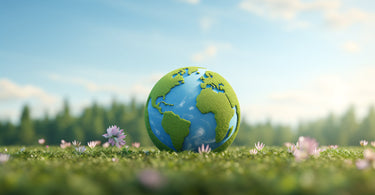
March is a busy month. Not just in the school-run, or back-to-back-meetings sense. Environmentally. More awareness days land in March than almost any other month of the year, and most of them carry genuine weight. It is one of the greenest months of the year.
And these are not your typical calendar fillers; each one has a specific history, a specific problem it was created to address, and a reason it still matters today.
Some of them most people know, but there are still quite a few out there that most of us have never heard of.

Well, it’s time to change that.
|
Day |
Date |
What it's about |
|
World Wildlife Day |
3 March |
Celebrating biodiversity and raising awareness of the threats facing wild fauna and flora globally |
|
Global Recycling Day |
18 March |
Pushing for recyclable materials to be treated as a resource rather than waste |
|
International Day of Forests |
21 March |
Highlighting the vital role forests play in climate, biodiversity, and water supply |
|
World Water Day |
22 March |
Advocating for sustainable water management and clean water access for the 2.2 billion without it |
|
Earth Hour |
28 March |
A global lights-off event marking collective commitment to the planet; 8:30 to 9:30 pm local time |
World Wildlife Day – 3 March
What it is: An annual United Nations observance dedicated to the world's wild fauna and flora – celebrating biodiversity and raising awareness of the threats facing it, from habitat loss and climate change to illegal trade.
How it started: On 3 March 1973, the Convention on International Trade in Endangered Species of Wild Fauna and Flora (better known as CITES) was signed in Washington. It was a landmark moment: the first international treaty designed specifically to ensure that cross-border trade didn't drive species to extinction. Forty years later, in 2013, Thailand proposed marking that anniversary with a dedicated global day. The UN General Assembly agreed, declaring 3 March World Wildlife Day on 20 December 2013. The first official celebration took place on 3 March 2014.
Why it matters: CITES has expanded from protecting a few hundred species in the 1970s to regulating trade in more than 40,000 today. And yet, roughly a million species are currently at risk of extinction – a rate of loss that far outpaces anything in recorded history. World Wildlife Day reminds us that it isn't an abstract problem or some cliché activist cause. Wildlife underpins the food systems, water cycles, and medicine supplies that our own lives depend on. When species disappear, the consequences get very real.
How to get involved: A good place to start is looking at what you buy and where it comes from. Conventional cotton farming is one of the heaviest users of synthetic pesticides globally. They leach into soil and waterways, affecting the ecosystems that wildlife depends on. It's not the most obvious connection, but it's a real one. Something like swapping to organic cotton towels is a small, low-effort way to remove that demand. If you want to do more, WWF's website has an action centre with live petitions and conservation programmes you can support directly.
Global Recycling Day – 18 March
What it is: An annual campaign, recognised by the United Nations, pushing for recycling to be treated as a global priority, not just a local habit – and for recyclable materials to be seen as a resource rather than waste.

How it started: The idea was first floated back in 2015 at the World Recycling Convention by Ranjit S. Baxi, president of the Bureau of International Recycling (BIR). The date chosen for the first event (18 March 2018) was deliberately symbolic: it marked the 70th birthday of BIR itself, which was founded in 1948. The Global Recycling Foundation was set up to lead the day, and it's been growing every year since.
Why it matters: The world generates around 2.1 billion tonnes of waste annually. Much of it is recyclable. Much of it doesn't get recycled – either because of inadequate infrastructure, unclear guidance, or the simple fact that most people don't think about it much until there's a bin in front of them. The day's central argument is that recyclables should be considered the planet's "seventh resource" – alongside air, water, natural gas, coal, oil, and minerals – because the more we recover and reuse, the less we need to extract. Recycling currently saves over 700 million tonnes of CO₂ per year. That number is set to reach a billion tonnes by 2030.
How to get involved: Worth doing: a quick audit of your bathroom. How much of it is synthetic? How much is disposable? How much would you replace like-for-like without thinking? Small domestic decisions matter more than most people realise. An organic cotton loop bath mat over a synthetic rubber-backed one is exactly the kind of swap it's talking about. Natural material, no microplastics, considerably longer lifespan. The Global Recycling Foundation also has a map of local initiatives if you want to find something happening near you.
International Day of Forests – 21 March
What it is: A UN observance dedicated to raising awareness about the importance of forests – their role in the climate, in biodiversity, in water supply, and in the lives of the 1.6 billion people who depend on them directly.
How it started: The roots go back to 1971, when the Food and Agriculture Organisation of the United Nations (FAO) established World Forestry Day on March 21. It’s safe to say it flew well under the radar for a few decades. Then, in November 2012, the UN General Assembly passed a resolution formally proclaiming 21 March as International Day of Forests, giving it a broader mandate and a renewed global platform. The first celebration under that name was held on 21 March 2013.
Why it matters: Forests cover just over 30% of the Earth's land surface – and we're losing them at a rate of more than 13 million hectares a year. To put that in context, that's roughly the size of England, every single year. Deforestation accounts for somewhere between 12% and 18% of global greenhouse gas emissions. That’s comparable to the entire transport sector. Forests are the lungs of the planet and one of the primary mechanisms responsible for carbon absorption and storage. So, protecting them is not exactly optional, to put it mildly.
How to get involved: One way to think about it: support the materials that make deforestation less necessary. Bamboo grows faster than almost any other plant, needs no replanting, and requires no pesticides. Bamboo towels are a small, practical way to put that into everyday use rather than just thinking about it. The UN runs a dedicated forests platform at un.org, where you can find events and resources tied to the day.
World Water Day – 22 March
What it is: An annual UN observance focused on the importance of fresh water. It revolves around advocating for the sustainable management of water resources and highlighting the crisis facing billions of people who lack reliable access to clean water.
How it started: The 1992 UN Conference on Environment and Development in Rio de Janeiro — the original Earth Summit — produced Agenda 21, a sweeping framework for sustainable development. One of its recommendations was a dedicated international day for water. The UN General Assembly acted quickly, adopting the resolution in December 1992. The first World Water Day was celebrated on 22 March 1993, and it has been held every year since.
Why it matters: Fresh water covers less than 3% of the Earth's surface, and most of that is locked in ice caps or underground. Of the water that's actually accessible, demand is rising faster than supply. It’s driven by population growth, agriculture, and the effects of climate change on rainfall patterns and glaciers. And that’s without even mentioning water pollution. Today, around 2.2 billion people live without access to safe drinking water. The 2026 theme, Water and Gender, highlights a dimension of the crisis that's often overlooked: in many parts of the world, it's women and girls who bear the daily burden of water collection. World Water Day is a reminder that access to clean water is not evenly distributed – and the gap is only getting bigger.
How to get involved: It’s about the habits and small changes. Shorter showers, full washing machine loads, fixing that tap. Not exactly glamorous, but it adds up. A diatomite bath mat dries entirely on its own and never needs a wash cycle – a small, genuine water saving across a year of daily use. The UN's World Water Day site at worldwaterday.org runs a fresh campaign each year with practical actions tied to the annual theme.

Earth Hour – 28 March
What it is: A global movement organised by WWF in which individuals, businesses, and governments switch off non-essential lights for one hour. It’s meant to be a simple and symbolic act of commitment to the planet. It takes place on the last Saturday of March each year, from 8:30 to 9:30 pm (local time).
How it started: The concept was born in 2004, when WWF Australia began working with advertising agency Leo Burnett Sydney to find a way to engage the broader public on climate change. Finally, they came up with an idea for a mass, coordinated lights-off event under the working title "The Big Flick." WWF presented the concept to Fairfax Media and Sydney's then-mayor Clover Moore, both of whom backed it. The first Earth Hour took place on 31 March 2007 in Sydney. More than 2.2 million people and 2,000 businesses participated. That was enough to reduce the city's electricity demand by around 10%. The following year, the event went global: 50 million people in 35 countries took part. It has grown every year since, becoming the largest voluntary environmental action in history, now spanning 192 countries.
Why it matters: Earth Hour has always been clear that it's a symbolic act and not an energy-saving exercise. Obviously, a one-hour break from having the lights on does not solve climate change. But that was never the point. The point is a visible, collective statement: people everywhere, simultaneously, demonstrating that they care. Over the years, Earth Hour campaigns have contributed to real legislative outcomes; from marine protected areas in Argentina to forest protection in Uganda to climate legislation in Scotland and Switzerland. The hour is the symbol. The work it represents goes well beyond it.
How to get involved: Straightforward one: lights off at 8:30 pm on 28 March for an hour. Beyond that, WWF encourages people to make a personal pledge for the year: one habit, one swap, one commitment. earthhour.org has a pledge tool and a live map of global participation if you want to see just how many people are doing the same thing at the same time.
Common Ground
Five different days. Five different focus areas. But they all share the same goal – to protect our Planet. And there’s no shortage of dangers for it.
And they don’t ask for huge sacrifices. What they're asking for, collectively, is attention. The willingness to understand the problem, to make better, more informed choices, and to recognise that our individual habits – what we buy, how we use water, what we do with waste, what materials we choose. Because they add up.
The changes don't have to be dramatic. They can be really simple – a stone bath mat to save water. Saying no to the tenth phone upgrade this year. Turning the tap off while you brush your teeth. Fixing something instead of replacing it.
March gives you five good reminders. The other eleven months are a chance to act.
