
Beach towels are almost always featured on the short list of beach essentials. But why? Are regular bathroom towels not enough?
Well, no. Not for this, anyway. There are actual differences, and size, which is something everyone instantly thinks of, is only one of them.
A beach towel needs to dry quickly between swims, resist turning into a sand collector, survive regular exposure to sun and salt water, and still pack away without taking over your bag.
A standard bath towel, usually thick terry cotton and built for a bathroom, doesn't do any of that particularly well. And even more luxurious models, like a premium cotton or bamboo towel, won’t really do the trick either.
So, the question isn't really whether to get one. It's which one – and that’s exactly what we’ll try to answer today.
What They Need to Do Well
Obvious but needs to be said. Beach towels work harder than bathroom towels. They don’t get to sit comfortably on a heated rail all day.
Instead, they get stuffed into our bags, often while still damp, dragged across sand, spend the entire day in the scorching sun, and then get rinsed in salt water. All that in a single afternoon.
That’s a lot. And that’s why the criteria for a good beach towel are slightly different from what you’d prioritise at home.
Here’s what actually matters:
-
How quickly they dry – you want it to dry ideally between uses; certainly not fermenting at the bottom of your bag.
-
How resistant to sand they are – sand should brush off easily, not get stuck in the fibres; that’s why some models are called sand-free beach towels.
-
How big they are – extra large beach towels work better; they should be big enough to lie on comfortably, but practical enough to carry easily.
-
How easy they are to pack – especially important for travel; they should fold down small and light.
-
How durable they are – sun exposure, salt water, and repeated washing shouldn’t wreck them over one season.
-
How they feel over time – some materials degrade with washing; others genuinely improve.
That last point is worth keeping in mind. It’s not just about how they look and feel from day one – but also how long they stay this way.
Best Materials

-
Organic Cotton — a great all-round choice for a beach towel. Absorbent, soft, and gets better with every wash rather than degrading. Handles repeated sun and salt water well with no coatings or treatments to wear off. Grown without synthetic pesticides or fertilisers, an organic cotton beach towel is the perfect eco-friendly option that doesn’t compromise on performance.
- Cotton — shares most of organic cotton's qualities but is typically grown and processed with significant chemical input, which carries a heavy environmental toll. Based on pure performance, it can be a solid choice, but that can depend – they do come in different types of cotton.
-
Bamboo — naturally antibacterial, which helps prevent the damp smell that develops when towels don't dry fully between uses. Usually sold as a cotton-bamboo blend rather than pure bamboo. A good alternative, but it doesn't match organic cotton for durability or overall feel.
-
Linen — quick-drying and sheds sand well, with the appealing quality of getting softer with every wash. Lower absorbency than cotton and prone to wrinkling, also much less comfortable. A niche choice – but a valid one.
-
Microfibre — these towels are cheap, light, and popular, but come with serious issues – shedding nanoplastics is only one of them. That begs the simple question of whether the price and packability are enough to make them a good choice. We’ll answer it in a minute.
What’s Wrong with Microfibre Beach Towels?
Not a great choice, and the fact that it doesn’t really belong to the family of eco towels is only a part of the reason why.
Nevertheless, there are quite a few sources online that sing their praises; lightweight, durable, cheap, easy to pack and wash. But what’s the reality behind those claims?
This can be true as long as we can look past the obvious environmental and, frankly speaking, health concerns. Environmental issues stem from a simple fact – microfibre is made of synthetic threads, mostly polyester derived from petroleum. Apart from the energy-intensive production and releases of greenhouse gases, they are non-biodegradable.
Micro stands for ultra-thin synthetic fibres, which break off throughout their entire life cycle. Manufacturing, washing, even wearing – ultimately accumulating in ecosystems, causing soil and water pollution, and the food chain. They’re so small, we end up inhaling and ingesting them without even realising. That goes well beyond the well-being of the Planet – it’s about our health safety.
The fabric itself tells a similar story. It has very little to offer apart from the price – it doesn’t really absorb moisture, but wicks it. They feel rough against the skin and are simply uncomfortable to use on the beach, with not much cushioning or support.
What about recycled microfibre? It’s a good effort, but it doesn’t change anything about the performance. Plus, the nanoplastic shedding problem is still there, regardless of where the fibre originated.
Does Weave Type Matter?
Yes – a lot. In fact, weave type and construction can affect real-world performance even more than the material itself. The same fibre behaves very differently depending on how it’s woven.
-
Flat weave – sometimes called Turkish or hammam style – has no loops. It dries quickly, packs flat, and sheds sand easily, which is why they’re often recommended for beach use. The trade-off is that it's less plush and typically less absorbent than a quality terry construction.
-
Waffle weave sits between flat and terry. It offers better drying time than terry and more structure than flat weave, with a texture that helps reduce sand retention. Ribbed towels work on a similar principle – both are solid all-round options.
-
Terry weave is the classic looped pile used for most types of towels, and for good reason – it's highly absorbent and genuinely comfortable. Cheaper, looser terry can trap sand in its loops, which is not ideal. A dense, high-quality terry construction behaves quite differently, and remains the industry standard for serious beach towels.
-
Velour finish on terry – made by shearing the terry loops to create a smooth, dense pile, velour delivers an exceptionally soft, almost velvety surface against skin, and doesn’t compromise on absorbency. Paired with a terry reverse, this dual construction offers the best of both worlds. Comfort like nowhere else on one side, serious absorbency on the other. That’s a beach towel built to last.
Misona Beach Towels – What We Do Different
We’ve recently added a new product to our sustainable towel lineup – Misona’s very own Organic Cotton Beach Towels. It’s a perfect blend of all the qualities any top-of-the-line beach towel should have.

The cotton is 100% GOTS-certified organic – grown without synthetic pesticides or fertilisers, and certified across the entire supply chain, from farming through to finished product. It's also OEKO-TEX 100 certified, meaning no harmful dyes or chemicals were used in production.
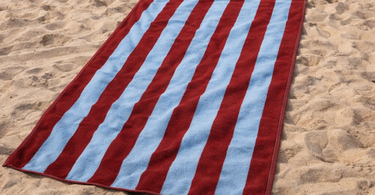
The construction follows the traditional dual-sided approach: cut velour pile on one side for a smooth, soft finish against skin, and absorbent terry loops on the reverse for drying off after a swim. The stripe pattern runs through both sides, so it always looks the part.
At 550GSM and 90 x 180cm, it's a proper heavyweight towel. Substantial enough to be comfortable to lie on – even on sun loungers or poolside – and absorbent enough that it doesn't start feeling wet after a single use. A sewn-in hanging loop along the longer edge makes it easy to dry between uses – useful at home, even more so when you're away.
Best Beach Towels - Frequently Asked Questions
What is the best material for a beach towel?
For most scenarios, organic cotton is the best all-round choice. It's absorbent, durable, naturally comfortable against skin, and improves with washing rather than degrading. A velour and terry dual construction gives you softness and absorbency in one towel. Linen is a valid alternative if quick-drying is your main priority, though it's less absorbent and comfortable.
What makes a towel sand-free?
Sand-free beach towels typically use a tight flat weave that prevents sand from embedding in the fibres, making it easy to brush off. They don't repel sand entirely, but they release it far more easily than terry towels. A flat-woven cotton towel with a tight construction behaves in much the same way.
Should beach towels be thick or thin?
It depends on the construction. A well-made heavyweight cotton towel – particularly the velour- and-terry combination – absorbs significantly more water without feeling wet, and offers real comfort. The difference between that and a thin, lightweight towel is noticeable the moment you use one. Weight becomes a drawback if the towel is poorly made or slow to dry.
How often should you wash a beach towel?
After every two to three uses is a reasonable rule of thumb – more frequently if you're using it daily in the sun and salt. Washing at 30–40°C with a mild, eco-friendly detergent and drying thoroughly between uses keeps them fresh and extends their lifespan. Avoid fabric softeners, as these coat the fibres and reduce absorbency over time.
Are bamboo beach towels worth it?
They can be – particularly blends. Bamboo's natural antibacterial properties make it a reasonable choice for beach use, where towels often don't dry fully between swims. A bamboo-cotton blend tends to offer a good combination of softness and practicality.

