
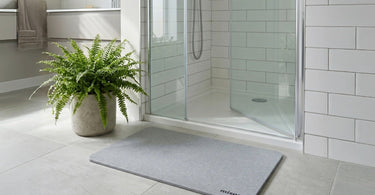
If you're choosing between a standard and large bath mat, the bigger option isn't necessarily the better one. The right choice depends on your bathroom layout, available space and how you use the room.
And yes; the timing of posing this very question is not random at all.
We actually have a very exciting new addition to our selection of sustainable, eco-conscious products - a large stone bath mat.
We know perfectly well that options are great - but they add a new set of doubts and unanswered questions.
Which one should you get - standard or the large one?
Standard vs Large Bath Mat: What's Changed?
Up until very recently, our flagship diatomite bath mat had only been available in the standard size (39 cm x 60 cm), but we’ve added a bigger variant (50 cm x 80 cm).
The same sleek minimalist design, the same colour options, the same high-grade diatomite, the same comfort. It doesn’t do more but gets more done.
This is still the perfect, low-maintenance alternative to traditional bath mats - just more of it. It got bigger to cover more ground, but not thicker, so it slides under the bathroom furniture as easily as ever.
Since numbers may not tell the whole story, and the difference between them may not seem dramatic, here’s the visual representation.

Because it is indeed quite substantial.
-
Standard: 39 × 60 cm = 2,340 cm²
-
Large: 50 × 80 cm = 4,000 cm²
So, the large version has roughly 71% more surface area.
But does it mean it’s better? Not per se - just bigger. It’s only better if it fits your bathroom. We’ll get into that very soon.
What's Trendier?
Our honest advice - don't worry about the trends too much, focus on functionality. Looks and aesthetics are important, but our regular diatomite bath mats and large diatomite bath mats are available in the same colour variants.
There's not a shadow of doubt that stylistically they will fit right in just about any bathroom, let alone a modern one. So, it's more about two things - practical value and visual balance.
You should consider the following first:
-
Size of your bathroom - Anything under 3.5m² is on the smaller side, and 5.5m² or more is generally where you start getting real flexibility. Not a hard line either way, just a general sense of limited space versus a bit more open one.
-
Shape of your bathroom - Rarely mentioned, but could matter more than the size. A long, narrow layout can match a square room on total area and still leave far less actual width at any single point.
-
Shower or bathtub - A shower spreads water across an open area as you move through it. A bath delivers you to one landing spot as you step over the rim, needing less width to catch you.
-
Door swing and clearance - A door swinging inward claims floor space regardless of the room's total size. A mat that fits on paper can still catch the door in practice.
-
Underfloor heating - It’s simple, a larger mat covers more of the heated floor area. Usually not a deal-breaker, but something to consider.
-
Your floor - If you want to show off your fancy tiles, then there's a less practical but just as valid reason to go for a standard stone bathroom mat. It leaves more of it visible. Large simply covers more of what you paid for.
Does the Size Change How It Dries?
The obvious guess: more stone holding more moisture means the large mat should take longer to dry. Fair assumption.
Thankfully, that's not really how it works.

Diatomite doesn't dry like a towel, shedding water off the surface until it evaporates - it draws water down into a network of microscopic pores in the stone itself, the same structure that gives it its natural anti-mould properties.
Basically, that absorption mechanism doesn't change with size.
Whether total dry time does is something we haven't measured mat-for-mat, so we won't claim otherwise - what doesn't change is how the stone actually does the job.
Choosing the Right Size Means Buying Once
One of the most sustainable choices you can make isn't simply choosing an eco-friendly product - it's choosing the right one for your home from the start.
A bath mat that's too small may leave you wishing for more coverage, while one that's too large can feel out of place in a compact bathroom. Taking a little time to find the right size means you're far more likely to be happy with your choice for years to come.
Like all of our stone bath mats, both the standard and large versions are made from naturally absorbent diatomite.
Unlike traditional fabric bath mats, they don't need regular machine washing to stay fresh, helping to reduce water and energy use over their lifetime. There's no need for frequent tumble drying either, as the stone naturally absorbs moisture and dries quickly between uses.

Designed to last for years with simple care, a diatomite bath mat is a long-term alternative to repeatedly replacing worn fabric mats.
By choosing the size that best suits your bathroom, you're investing in a product that delivers everyday practicality while supporting a more considered, lower-impact approach to your home.
How Much Floor Should a Bath Mat Cover?
The answer is usually purely practical. It should cover enough floor space to catch all the water from your wet feet as you step out of the shower or a bathtub. That’s it.
There are also some general good practices for all kinds of bath mats:
-
Leave a gap: 5 to 10cm between the mat and the skirting board, cabinet or bath is enough - it doesn't need to touch everything around it.
-
Keep it flat: Don't let it ride up against the bath edge or a shower door track. It should sit completely flat, not curl at one side. Not a problem with a large diatomite bath mat, of course.
-
Room for both feet: If one foot's landing on cold floor instead of the mat, it's not big enough for where you've put it.
But there’s also one more thing to consider. It’s more subtle than that. Does it fit the space?
This isn't really just about whether it physically fits the bathroom. It's more about whether it looks like it belongs there.
The visual balance.
Too small, and it sits in the middle of the floor like an island, cut off from whatever it's meant to be catching water for.
Too big, and it swallows a room, overpowers the surroundings and draws too much attention.
Three things worth checking:
-
Does it actually catch the water where you step out?
-
Does it leave enough floor still visible around it?
-
Does it look like a deliberate choice?
Run these quick tests, and you’ll know exactly what to do.
One Mat or Two?
That’s even a better question than bigger or smaller.
Bathrooms with more than one wet zone already split their floor this way, doesn’t matter if you have a cotton or organic cotton bath mat.

A large mat by the shower, soaking up the water as you’re stepping out. A standard mat in front of the sink, doing a smaller job well. Neither one is covering for the other, and neither has to.
And it’s not uncommon to use both at the same time for families. One mat, wherever it ends up, is only ever covering one of those spots properly. With two bath mats, both are actually taken care of.
Or the other side of this equation - a smaller bathroom with a shower and a sink close together, no real distance between them. That's not really a two-mat situation. One large mat, positioned to catch both, likely does the job better than splitting it. It’s not a rule of course, more of a floor plan question.
Plenty of households already split coverage this way with towels and rugs elsewhere in the house. Bath mats aren't any different.
Is a Large Bath Mat Worth It?
Bath mat dynamics can be trickier than expected. It should be simple - smaller bathroom, smaller bath mat; bigger bathroom, bigger bath mat.
But it’s clear there’s much more to it. One thing you won’t have to worry about is how functional it is, and how good it looks - in either size.
But the question was never: is bigger better?
It's: which one belongs in your space?
