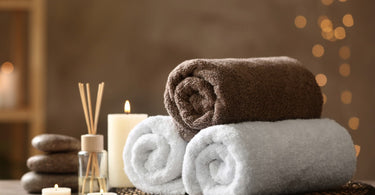
A good spa towel is big enough to wrap around you, dense enough to feel substantial, and built to dry you and then - dry itself.
Finding a good spa towel is tricky. That’s because more than being a towel type and a whole different category, it represents something. It’s more of a symbol than a product sheet.
And the reason for it is very simple, really. That relaxing, rejuvenating spa visit we had a while ago left a lasting mark. And part of that day was this plush, luxurious towel. It’s the one piece of a spa visit we can take home. The pool, the peace, the treatment room - none of it fits in a suitcase. But the towel does.
It’s about replicating that experience.
So, we think back - what did it look like? Probably thick, white, rolled neatly at the end of the treatment bed. Heavy must mean good.
But the heavy ones are often the slowest to dry, and a towel that stays damp is no luxury at all.
The big question is - what makes an actual difference? Size, weight and how the loops are built. And whether the towel already hanging in your bathroom can do the job.
What’s the Difference Between a Spa Towel and a Bath Towel
It mostly comes down to size, weight and how it feels in the hand.
- Size: A spa towel is cut generously. The idea is to wrap it around you, tuck it in and walk to the next room without having to hold it shut. A standard bath towel is noticeably smaller - ours run around 70 x 125-130cm - and for drying that's plenty. Wrapping is another matter. A bath sheet, at 100 x 150cm, does it comfortably. We've covered what each towel size is for separately.
- Weight: Weight is the second difference. Spa towels tend to feel dense and substantial, a little like being wrapped in a blanket.
- The Feel: The most elusive of the three. A plush surface that stays warm, with no thin patches at the edges.
None of this makes it a different kind of towel. It's a bath towel, or a bath sheet, at the generous end of every measure.
Is a Heavier Towel Always Better?
Not necessarily. GSM is grams per square metre - the weight of the fabric, nothing more.
A heavier towel carries more cotton, so it holds more water. And more water often means more drying time. That’s why thick terry is the slow one on the rail.
 So, the right weight depends on the needs. A busy spa washes towels all day and needs them back quickly, so some lean lighter.
A home bathroom has hours between uses, and the extra weight pays off in feel. Suppliers don't agree on the numbers either - some tell spa and salon buyers to keep robes at 300-400 GSM, while others say spa-positioned properties usually go heavier.
Weight isn't the only thing in play. A study of terry fabric found that loop density - how tightly the loops are packed - was the biggest factor in how much water a towel took up, ahead of yarn twist, loop shape and the number of plies. Two towels at the same GSM can absorb water in a very different way.
So, treat GSM as a starting point. On its own, the figure doesn't tell you the whole story.
Loops, Fibre and Weave
Construction does the work the GSM figure can't.
Terry, the classic loop, is the standard for absorbency, and the loops are the whole point. Waffle dries quickest but won't give you that plush feel.
Ribbed sits in between, drying faster than plain terry. Velour, where the loops are sheared off one side, feels smoother but gives up some absorbency. Our guide to weave types goes through each one, so we'll leave the detail there.
Fibre matters just as much. Longer fibres make softer, stronger yarn. And zero twist skips the twisting altogether - when the cotton is long enough to hold together without it, the loops sit more open, and the towel feels plush without feeling heavy.
Quiz Time - Can the Towel You Already Own Do the Job?
Oftentimes, the answer is simply yes. Before you buy anything, check it against four things.
- Size: can you wrap it around you and tuck it in? If you have to hold it shut, it's a bath towel, not a spa towel.

- Weight: pick it up. A good one feels dense and springy, and a thin one lets the light through the loops.
- Drying: does it still feel damp the next day? A towel that never fully dries is a problem no spa would tolerate - our guide to storing towels covers the rest.
- Wear: flattened loops, a rough hand, a musty smell that survives the wash. Those usually mean it's tired, and making towels soft again is the next step.
If it passes, you already own a spa-fit towel. If it fails on size alone, a bath sheet should be enough to sort that.
Our Misona Towels
Let’s get back to the three tests - size to wrap, weight to feel, loops that dry in time. Each of our eco towels is strongest at one of them, and we'll say where it gives a little back.
- Size - the striped one: our large organic cotton beach towel is 90 x 180cm, which is 30cm longer than our bath sheet - and length is what a lounger needs. It's 550 GSM, 100% GOTS-certified organic cotton, with cut velour on one side to lie back on, absorbent terry loops on the reverse for drying, and a sewn-in loop for the changing-room hook. It's a striped beach towel, and spa colours tend to be plain, so we'd reach for the black and natural, the navy and sky blue, or the pine and sage. The velour side absorbs a little less, so the loop side does the drying.
- Weight - the ribbed one: our organic cotton bath towel is 650 GSM, ribbed, 100% organic cotton, made in Turkey and GOTS-certified. Dense, springy and generous - the one that feels like the spa. The ribbed pile dries quicker than plain terry, though at that weight it still wants a rail with room around it.
- Loops - the bamboo one: our bamboo towels come in at 580 GSM, in a blend of 65% cotton and 35% bamboo viscose, made in Portugal and certified to OEKO-TEX Standard 100. Zero twist keeps the loops open, so the pile feels soft without feeling heavy, and there's less cotton to dry than in the ribbed towel. A lighter wrap, with a little less of that blanket feel.
Spa at Home
As important as they are, a spa retreat is about more than just a set of towels. All that hard work deciding and weighing the pros and cons can go to waste without the right accessories. None of which, perhaps, as crucial for that spa feel at home as a quality bath mat.
And that’s where our diatomite bath mat comes in. It’s a soft rock formed from fossilised algae that lived in Cretaceous seas, cut into a slab just 1cm thick, so it looks like a stone tile laid beside the bath.
It comes in timeless colours with a sleek design that fits right into the serene aesthetic. It’s fine with underfloor heating, and it feels closer to a wooden mat than to cold stone.
There’s nothing to wash, either. A small sheet of sandpaper comes in the box - a light sanding lifts stains and restores absorbency. It’s the only care a spa floor ever needs.
Want more room to stand and dry off? The extra large stone bath mat is 50 x 80cm, against 39 x 60cm for the standard size.
Spa Towel FAQs
What’s the difference between a spa towel and a bath towel?
Mainly size and weight. A spa towel is cut larger so it wraps and stays put, and it tends to be denser and plusher. It’s the generous end of the same product, not a separate one.
What size is a spa towel?
Big enough to wrap fully and tuck in, which usually means a bath sheet. A bath sheet runs around 100 x 150cm, against 70 x 125cm for a standard bath towel. The other sizes are in our guide to towel types.
What GSM is best for a spa towel?
There’s no single answer, and suppliers don’t agree on one. A higher GSM feels plusher and holds more water, but it dries slower. For a home bathroom with hours to dry between uses, going heavier makes sense. Then check the construction.
How do you fold and roll a towel like a spa?
Fold it lengthways into thirds, then roll it up from the short end. Rolled towels stand upright, you can see each one at a glance, and air moves between them. The full method is in our guide to storing towels.
Can a bath sheet work as a spa towel?
Yes, it’s the closest everyday match. The extra length wraps all the way round and tucks in, but it holds more water and takes longer to dry, so give it a rail with room around it.
Does fabric softener help?
It can make a towel feel softer, at a cost.

Testing at Hohenstein Laboratories found softener can reduce how well terry towels absorb water. A 2022 study found it offset some of the roughness that line-drying leaves behind. For a towel whose job is drying you, we’d skip it and keep the absorbency.
How do you keep spa towels soft and absorbent?
Go easy on the detergent, don’t overload the machine, and make sure the towel is fully dry before it’s folded away. Washing temperature made no significant difference to softness in that same 2022 study, so follow the care label - on ours it’s cold or warm, never hot. Our guide to making towels soft again covers the rest.
